Tag Archives: industrial_inkjet

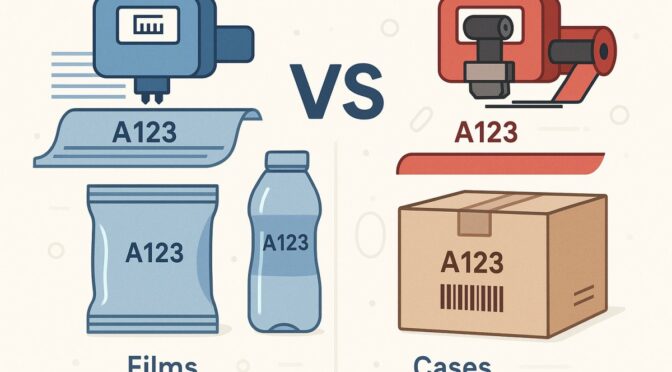
TIJ vs Thermal Transfer Ribbon for Product Coding: A Practical Guide for Films, Pouches, and Cases

What “TIJ vs thermal transfer ribbon” really means

Thermal transfer (often called TTO/TTR) uses a heated printhead to melt resin or wax‑resin ink from a ribbon onto the substrate. The result is durable, abrasion‑resistant codes well‑suited to flexible films, pouches, and form‑fill‑seal packaging.

TIJ (thermal inkjet) uses drop‑on‑demand technology with a cartridge‑based ink supply. Advantages include faster changeover, no consumable ribbon to load or waste, no printhead wear from ribbon contact, and a simpler operator workflow.

Decision rule at a glance

  • Flexible film at sustained high line speed (pouches, flow wrap, FFS bags) where abrasion resistance and “ribbon‑quality” edges are non‑negotiable: choose thermal transfer.
  • Corrugated cases and folding cartons across varied line speeds where changeover speed and per‑code consumable cost dominate: choose TIJ.

Operator workflow: where time is lost or saved

  • TTO/TTR tasks: ribbon loading and registration, ribbon replenishment as it depletes, and periodic printhead inspection for wear. Each step is straightforward but adds touches and stoppages, especially on short runs.
  • TIJ tasks: swap a cartridge when ink runs out. No ribbon handling and no contact‑driven printhead wear reduce unplanned maintenance and training burden.

Across multi‑SKU days, those touches add up. TIJ tends to compress changeovers and restart times; TTR tends to offer fewer surprises once dialed in on a single film and format at speed.

Durability vs economics: match to substrate and risk

On flexible film, TTR’s resistance to scuffing and chemical wipe is meaningfully better than typical TIJ inks. If pouches rub together in cases, slide through cartoners, or see sanitizer wipe‑downs, TTR preserves legibility and barcode contrast with a wide margin.

On corrugated cases, TIJ codes are typically more than durable enough for downstream handling. Here, the economics shift: no ribbon waste, fast cartridge swaps, and fewer stoppages often outweigh the extra abrasion margin that TTR provides but the process doesn’t need.

Examples by packaging format

  • Form‑fill‑seal snacks or confectionery on oriented films: thermal transfer protects codes during high‑friction conveying and case packing.
  • Shipper cases and subscription cartons with frequent SKU changes: TIJ reduces setup time and per‑code consumables, while maintaining scannable barcodes and clear lot/expiry marks.
  • Mixed operations (films and cases on adjacent lines): many plants standardize on TTR for film lines and TIJ for case coding, simplifying training per area.

Quality control: simple tests that prevent rework

  • Rub and wipe checks: on film, perform a quick finger rub and a light isopropyl wipe on a fresh code. Expect TTR to hold fast; if TIJ is under consideration for film, verify the code resists smearing before approval.
  • Barcode grading: verify 1D/2D symbols with a handheld verifier at production speed to confirm edge acuity and contrast meet your customer’s grade requirement.
  • Image capture: log sample images per lot with a vision sensor or handheld scanner to document legibility and date/lot accuracy.

Cost and uptime considerations

  • Consumable handling: TTR adds ribbon rolls to inventory and disposal; TIJ removes ribbon entirely and limits inventory to cartridges.
  • Short runs: TIJ minimizes time lost to ribbon changes between SKUs. TTR shines on long, steady runs where a single ribbon grade matches the film all day.
  • Maintenance exposure: TTR printheads contact ribbon and can wear; TIJ avoids ribbon contact, reducing that specific wear mode.

Procurement note

ink4mail.com supplies TIJ cartridges for HP‑compatible print engines (including Kao Collins Max 3, Super Fast Black, and others) and does not currently sell thermal transfer ribbon. This guide is provided to help operators choose the right technology for the substrate and risk profile, not to push one product line.

Quick checklist: TIJ vs thermal transfer ribbon

  • Is the substrate a flexible film or pouch that will see rubbing or chemical wipes? Favor thermal transfer.
  • Are you coding corrugated cases or coated cartons with frequent SKU changeovers? Favor TIJ.
  • Is high line speed on film critical with zero tolerance for scuffing? Favor thermal transfer.
  • Do consumable simplicity, fast restarts, and minimal operator touches drive OEE? Favor TIJ.
  • Need the same coder to handle varying carton sizes and intermittent speed? TIJ’s cartridge system adapts quickly.

Bottom line

Use thermal transfer for flexible films where abrasion resistance and long, steady runs dominate. Use TIJ for cases and cartons where consumable cost, changeover speed, and straightforward operation improve throughput without sacrificing readable codes.

TIJ vs CIJ Ink for Production Coding: The Practical Case for Thermal Inkjet

Searching for “TIJ vs CIJ ink” usually means a production team is weighing print quality, uptime, and operating cost against speed and substrate flexibility. In simple terms: TIJ (thermal inkjet) is a drop-on-demand technology that fires droplets only when a code is needed; CIJ (continuous inkjet) maintains a continuous ink stream and electrostatically deflects selected droplets to the substrate, recirculating the rest through a gutter.

Print quality and compliance: why resolution matters

For small human-readable codes, crisp lot codes, and scannable barcodes, TIJ typically delivers higher print resolution than CIJ. HP-based TIJ 2.5 print engines support up to 600 dpi, versus CIJ’s typical 60–120 dpi range, producing crisper barcodes and smaller human-readable codes. That difference shows up immediately in barcode grading and the tolerance window for imperfect packaging surfaces.

Operationally, higher resolution gives more room to hit Grade A/B scans with less tweaking, especially on dense QR and reduced-height barcodes. It also allows shorter code blocks at the same legibility, which helps fit variable data into constrained print areas on cartons, mailers, and pouch seals.

Practical methods to lock in barcode performance

  • Use a verifier that grades to ISO/IEC standards and spot-check after each job change; capture reference images alongside grades to speed troubleshooting.
  • Standardize controller templates (font, size, error correction for 2D, and contrast targets) so changes are controlled and auditable.
  • Keep a documented routine for head alignment and substrate presentation; steady fixtures and consistent standoff reduce edge raggedness and voids.

Uptime and operator workflow: fewer moving parts, faster changeovers

TIJ printheads are cartridge-based — the print engine and ink supply are integrated into a replaceable cartridge — eliminating fluid plumbing, makeup fluid, pumps, filters, and solvent recovery systems. Operator workflow is cartridge-swap based — no pump or filter maintenance, no purge cycles, no priming routines — versus CIJ’s daily fluid checks, solvent makeup, and scheduled service intervals.

In practice, that means shorter training time, fewer stoppages tied to fluids management, and simpler end-of-shift procedures. Cartridge swaps become a quick, documented task rather than a maintenance event, which helps keep responsibility with production rather than requiring technical staff on every shift.

Implications for staffing and safety

With TIJ, less exposure to open fluids and fewer steps reduce handling risks and cleanup. Cross-training packout or kitting operators to load a cartridge, select the job, and verify a sample can cover most day-to-day needs, freeing maintenance teams for higher-impact work.

Footprint, capital, and the real drivers of total cost

TIJ requires less floor space, lower upfront capital, and shorter operator training than CIJ, which makes it the right call for many coding applications where CIJ-level line speeds and substrate range aren’t required. The total cost picture favors TIJ further when accounting for service intervals, unplanned downtime tied to fluid systems, and the time sink of daily checks.

Procurement decisions improve when evaluated against production reality: target codes and sizes, barcode grading requirements, typical line speeds, substrate mix, and available operator skill. If codes are short, areas are tight, and substrates are consistent, TIJ tends to provide the lowest risk and the cleanest compliance path.

Where CIJ still fits

CIJ remains a strong option where extreme line speeds and a wider substrate range are business-critical. If a plant runs diverse materials at high throughput and the codes are relatively low resolution, the CIJ trade-offs in maintenance and consumables may be justified by application demands.

Decision checklist: TIJ vs CIJ ink for your lines

  • Code requirements: If you need crisper barcodes, small text, or dense 2D, TIJ’s up to 600 dpi (HP-based TIJ 2.5) outperforms CIJ’s typical 60–120 dpi.
  • Uptime and labor: TIJ’s cartridge-swap model avoids pumps, filters, purge/prime routines, and solvent makeup cycles common to CIJ.
  • Compliance assurance: Higher resolution simplifies achieving consistent barcode grades and clean human-readable dates and lots.
  • CapEx and space: TIJ’s smaller footprint and lower capital can shorten approval cycles and speed deployment.
  • Application limits: If your operation truly requires CIJ-level line speeds and broader substrate range, factor that need explicitly before deciding.

Supply you can trust

For operations standardizing on TIJ, ink4mail.com is a KAO Collins authorized reseller supplying TIJ cartridges for HP-compatible print engines used on production lines for date codes, lot numbers, expiration dates, and lot tracking. Reliable consumables, consistent imaging performance, and straightforward operator workflows make TIJ a practical choice for many mailing, fulfillment, packaging, and industrial printing environments weighing TIJ vs CIJ ink.