
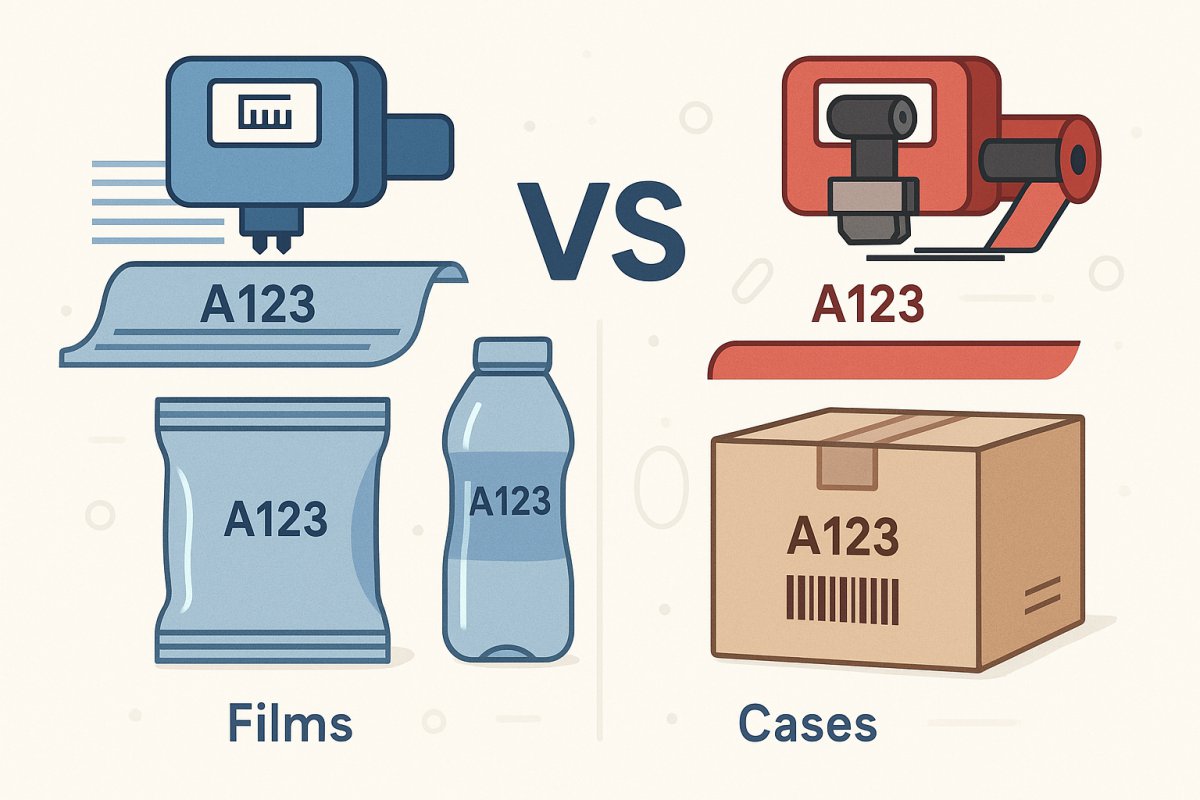
What “TIJ vs thermal transfer ribbon” really means
Thermal transfer (often called TTO/TTR) uses a heated printhead to melt resin or wax‑resin ink from a ribbon onto the substrate. The result is durable, abrasion‑resistant codes well‑suited to flexible films, pouches, and form‑fill‑seal packaging.
TIJ (thermal inkjet) uses drop‑on‑demand technology with a cartridge‑based ink supply. Advantages include faster changeover, no consumable ribbon to load or waste, no printhead wear from ribbon contact, and a simpler operator workflow.
Decision rule at a glance
- Flexible film at sustained high line speed (pouches, flow wrap, FFS bags) where abrasion resistance and “ribbon‑quality” edges are non‑negotiable: choose thermal transfer.
- Corrugated cases and folding cartons across varied line speeds where changeover speed and per‑code consumable cost dominate: choose TIJ.
Operator workflow: where time is lost or saved
- TTO/TTR tasks: ribbon loading and registration, ribbon replenishment as it depletes, and periodic printhead inspection for wear. Each step is straightforward but adds touches and stoppages, especially on short runs.
- TIJ tasks: swap a cartridge when ink runs out. No ribbon handling and no contact‑driven printhead wear reduce unplanned maintenance and training burden.
Across multi‑SKU days, those touches add up. TIJ tends to compress changeovers and restart times; TTR tends to offer fewer surprises once dialed in on a single film and format at speed.
Durability vs economics: match to substrate and risk
On flexible film, TTR’s resistance to scuffing and chemical wipe is meaningfully better than typical TIJ inks. If pouches rub together in cases, slide through cartoners, or see sanitizer wipe‑downs, TTR preserves legibility and barcode contrast with a wide margin.
On corrugated cases, TIJ codes are typically more than durable enough for downstream handling. Here, the economics shift: no ribbon waste, fast cartridge swaps, and fewer stoppages often outweigh the extra abrasion margin that TTR provides but the process doesn’t need.
Examples by packaging format
- Form‑fill‑seal snacks or confectionery on oriented films: thermal transfer protects codes during high‑friction conveying and case packing.
- Shipper cases and subscription cartons with frequent SKU changes: TIJ reduces setup time and per‑code consumables, while maintaining scannable barcodes and clear lot/expiry marks.
- Mixed operations (films and cases on adjacent lines): many plants standardize on TTR for film lines and TIJ for case coding, simplifying training per area.
Quality control: simple tests that prevent rework
- Rub and wipe checks: on film, perform a quick finger rub and a light isopropyl wipe on a fresh code. Expect TTR to hold fast; if TIJ is under consideration for film, verify the code resists smearing before approval.
- Barcode grading: verify 1D/2D symbols with a handheld verifier at production speed to confirm edge acuity and contrast meet your customer’s grade requirement.
- Image capture: log sample images per lot with a vision sensor or handheld scanner to document legibility and date/lot accuracy.
Cost and uptime considerations
- Consumable handling: TTR adds ribbon rolls to inventory and disposal; TIJ removes ribbon entirely and limits inventory to cartridges.
- Short runs: TIJ minimizes time lost to ribbon changes between SKUs. TTR shines on long, steady runs where a single ribbon grade matches the film all day.
- Maintenance exposure: TTR printheads contact ribbon and can wear; TIJ avoids ribbon contact, reducing that specific wear mode.
Procurement note
ink4mail.com supplies TIJ cartridges for HP‑compatible print engines (including Kao Collins Max 3, Super Fast Black, and others) and does not currently sell thermal transfer ribbon. This guide is provided to help operators choose the right technology for the substrate and risk profile, not to push one product line.
Quick checklist: TIJ vs thermal transfer ribbon
- Is the substrate a flexible film or pouch that will see rubbing or chemical wipes? Favor thermal transfer.
- Are you coding corrugated cases or coated cartons with frequent SKU changeovers? Favor TIJ.
- Is high line speed on film critical with zero tolerance for scuffing? Favor thermal transfer.
- Do consumable simplicity, fast restarts, and minimal operator touches drive OEE? Favor TIJ.
- Need the same coder to handle varying carton sizes and intermittent speed? TIJ’s cartridge system adapts quickly.
Bottom line
Use thermal transfer for flexible films where abrasion resistance and long, steady runs dominate. Use TIJ for cases and cartons where consumable cost, changeover speed, and straightforward operation improve throughput without sacrificing readable codes.